
|
Wakeup Diet™ |
| Tweet |
|
For the Naysayers
|
What? You're skeptical about the Wakeup Diet™ and how it might help you? You should also be skeptical about the drug treatments for narcolepsy. Read the circulars that come with these drugs! The medical community doesn't know how Provigil and Xyrem work. This statement is buried in the fine print about both products. (See our labeling extracts below.) As to how effective these drugs are, and the many side effects: You'll find ample admission of potential problems in both areas. Sex and Narcolepsy Stimulants: Bad Mix. Men on stimulants can expect occasional or frequent ED (erectile dysfunction). Stimulants constrict the blood vessels in the extremities. This constriction shrinks the male genitalia. They retract as they do during immersion in cold water. Even young males might require medication for sexual dysfunction. For either sex on a stimulant, orgasm can be difficult to achieve or uncomfortable.1, 2, 3, 4, 5 (See footnotes) |
|
>>> Those who object to the Wakeup Diet™ tend to exaggerate what their medications can achieve.
Drugs aren't helping. Recently, two narcoleptics admitted to me that they’d quit the medication because of problems. For one of these people, a narcolepsy prescription had caused heart damage. Yet both people seek “better medication.” (There is none.) I suggested the Wakeup Diet™. Not only could the program help, but it could improve a patient’s general health. The second person claimed that “drugs are easier and involve less thought than changing my routine.” Yet this person admits that the drugs aren’t helping!
>>> Some confusion must result from the term “diet.”
No calorie-counting. You'll be happy to hear this: The Wakeup Diet™ program involves no calorie counting and no weight loss. Instead, this is a weight-neutral system. The purpose of the Wakeup Diet™ is daytime alertness and nighttime sleep quality. Although someone could lose weight by adjusting the program, consider my own weight. It's been stable for decades. I wear the same size bathing suit as in high school.
Drugs are a different matter. If you expect Cloud 9 from a drug, then you're dreaming. This isn't a perfect world
and never will be, despite what pharmaceutical ads might promise. Don't let Cloud 9 obscure the reality of your life.
True, every change to one’s routine carries a risk. Yet we’d guess that a balanced and timed diet, plus daily exercise
are safer than stimulants and depressants. Drugs depend on and deplete one’s resources. They simply can’t nourish the
system. Yet food and exercise can and do provide nourishment.
— The Webmaster
How Provigil & Xyrem Work
Source: Provigil and Xyrem Labels
From Provigil CircularCLINICAL PHARMACOLOGY The precise mechanism(s) through which modafinil promotes wakefulness is unknown. Source: “FDA Approved Labeling Text for NDA 20-717/S-005 & S-008 Approved-23-Jan-2004” See...Provigil circular. |
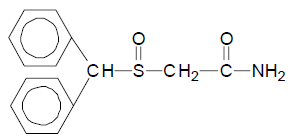
Chemical structure of Provigil (modafinil) |
From Xyrem CircularCLINICAL PHARMACOLOGY The precise mechanism by which sodium oxybate produces an effect on cataplexy is unknown. Source: “NDA 21-196/S-005 FDA Approved Labeling Text dated 11/18/05, page 2” See...Xyrem circular. |
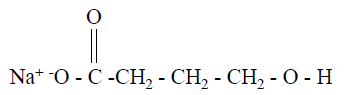
Chemical structure of Xyrem (sodium oxybate) |
Videos
What Your Doctor Didn't Tell You
| Click on images to see videos by Dr. Breggin and Bill Maher | |
Think stimulants are safe for narcoleptics?
Stimulants have a powerful impact on the functioning of the brain and mind. They can lead to addiction and abuse.7
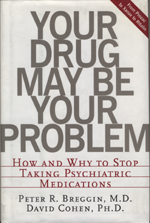
(Click repeatedly for quotes, p. 66.) |
...In many or most children, stimulants routinely cause rebound, involving a worsening of behavioral symptoms a few hours after the last dose. And especially with larger or more prolonged dosing, they can lead to severe withdrawal reactions such as “crashing,” which is characterized by extreme fatigue, depression, and even suicidal feelings (see Chapter 9).8 Stimulants can also cause the following: excessive stimulation of the brain, including insomnia and seizures, agitation, irritability, and nervousness; confusion and disorientation; personality changes; apathy, social isolation, sadness, and, very commonly, depression.9 ...Furthermore, stimulants can cause a variety of emotional disturbances that are mistakenly considered “therapeutic,” including flattened emotions and robotic behavior.10 ...Permanent tics, sometimes categorized as Tourette's syndrome, are a serious complication. They often start in the face and neck.11 ...Stimulants suppress the growth of the body, including height and weight.12 |
...All stimulant drugs can produce lasting abnormalities in the brain. The most extensive animal research has been conducted using amphetamines (Dexedrine, Adderall), which have been shown to cause permanent biochemical imbalances and cell death, even in short-term moderate doses.13
See Footnotes below.
A different study showed that people who reported using the amphetamines benzedrine and dexedrine were nearly 60 percent more likely to develop PD [Parkinson's Disease] than those who did not use these drugs. Benzedrine and Dexedrine are often prescribed to treat attention deficit disorder, narcolepsy, and traumatic brain injuries—and are also drugs of abuse.14
The body will always pay a price for consuming medicines, which usually have toxic effects. The 'side' / effects are not the only toxic effect of medications. Doctors learn in their introductory pharmacology course in medical school that all medications are toxic to varying degrees, whether side effects are experienced or not. Pharmacology professors stress never to forget that. You cannot escape the immutable biological laws of cause and effect through ingesting medicinal substances.15
Read frequently asked questions from naysayers...
Footnotes
1. N.A., “Adderall and effects on erections and libido,” vBulletin, last revised 2015, accessed December 31, 2015, http://www.addforums.com/forums/showthread.php?t=30844. This ADD Forum includes personal comments on the effects of stimulants on the male genetalia.
2. Irfan Tariq, M.D. “No Erection, Sex Drive, ADD And Adderall,” Steadyhealth.com, last revised 2015, accessed December 31, 2015, http://www.steadyhealth.com/No_erection__sex_drive__ADD_and_adderall_t85618.html.
3. “When humans take amphetamines, why can't they climax sexually?” Answers.com, accessed December 31, 2015, http://answers.yahoo.com/question/index?qid=20070531230706AADpwC1.
4. “Drugs and Supplements: Dextroamphetamine and Amphetamine (Oral Route): Side Effects,” Mayo Clinic, last revised 2015, accessed December 31, 2015, http://www.mayoclinic.com/health/drug-information/DR602653/DSECTION=side-effects. Scroll down to view this side effect: "Loss in sexual ability, desire, drive, or performance" [Incidence not known]
5. Peter Breggin, M.D. The Ritalin Fact Book: What Your Doctor Won't Tell You About ADHD and Stimulant Drugs. Cambridge, Massachusetts: Da Cappo Press, 2002. p. 62.
6. Ibid., 20-21, 33, 40, 62.
7. Breggin, Peter R., MD and David Cohen, PhD. Your Drug May Be Your Problem: How and Why to Stop Taking Psychiatric Drugs. Reading, MA: Perseus Books, 1999, pp. 65-66.
8. Ibid, p. 66.
9. Ibid..
10. Ibid..
11. Ibid..
12. Ibid..
13. Ibid..
14. Brey, Robin L., M.D., Editor in Chief. "From the Editor: Exciting New Research." Neurology Now (April-May 2011: 4).
15. Fuhrman, Joel M.D. Eat to Live: The Amazing Nutrient-Rich Program for Fast and Sustained Weight Loss, Revised Edition. New York: Little, Brown and Company, 2011, pp. 22-23.
Go to Page: 1 2 3 4 5 6 7 8 FAQ Index Home Back